
rather than intuition, and it is a concept often discussed among bettors who use süperbahis as part of their overall betting routine. Instead of simply trying to predict who will win, this strategy is focused on finding odds that are priced higher than they should be. When a bettor repeatedly places wagers with this type of advantage, the goal is to generate profit over time, even if many individual bets still lose.
In other words, value betting is less about short-term results and more about making smart decisions over a large number of wagers.
The idea behind value betting
The foundation of value bets is expected value, often shortened to EV. This concept helps measure whether a bet is worth making in the long run. If the odds offered by a bookmaker are lower than the true probability of an event, the bet has negative expected value and is not attractive for long-term profit. This is how bookmakers normally make money.
A value bet appears when the opposite happens. If your estimate of an outcome is more accurate than the bookmaker’s, and the odds offered are higher than the true chance of that outcome, then the bet has positive expected value.
For example, imagine you believe a team has a 60% chance of winning. Fair decimal odds for that probability would be around 1.67. If a bookmaker offers 2.00 instead, that price is better than it should be, and the bettor gains a statistical edge. A single bet can still lose, of course, but repeating this process many times can create a profitable overall result.
Why bookmakers create value opportunities
Bookmakers do not always price events perfectly. Odds move because of public betting patterns, market reactions, internal models, and simple delays in updating prices. Some bookmakers are especially fast and accurate, while others react more slowly. These differences create gaps, and those gaps are where value bettors look for opportunities.
This is why experienced bettors often compare odds between sharp bookmakers and softer ones. Sharp bookmakers are usually considered more efficient because their lines reflect the market more accurately. Softer bookmakers, on the other hand, may leave attractive prices available for a short time.
From manual research to automated tools
In the past, value betting required a huge amount of manual work. Bettors had to study statistics, compare odds by hand, and estimate fair probabilities on their own. That approach is still possible, but it is slow and difficult to scale.
Today, many bettors use automated value bet scanners to speed up the process. These tools monitor bookmakers in real time and highlight situations where the offered odds appear to be above true market value. Instead of spending hours searching manually, users can immediately see potential opportunities.
BetBurger’s value bet finder is one example of this type of service. It tracks odds from hundreds of bookmakers across dozens of sports and compares prices between target bookmakers and sharper market references. When the system detects that one bookmaker is offering significantly better odds than the market suggests, it flags the event as a potential value bet.
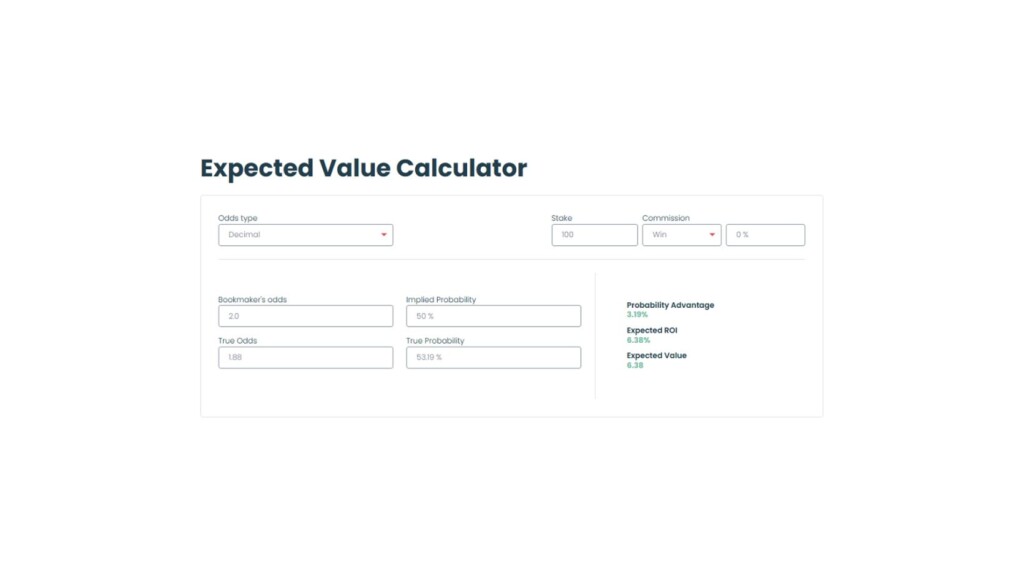
Moreover, you always can to calculate an expected value in just a few clicks using a buil-in to some services ev betting calculator.
Why automation matters
Automation makes value betting much more practical. First, it saves time by removing the need for constant manual comparison. Second, it helps bettors react quickly before bookmakers adjust the odds. Third, it can improve discipline by presenting opportunities in a structured format rather than relying on emotion or guesswork.
These tools often come with additional features as well, such as yield indicators, filters, and staking calculators. That makes it easier for bettors to decide how much to wager and which opportunities are worth taking.

As a result, value betting becomes less about endless searching and more about decision-making, execution, and consistency.
A strategy built for the long run
One important thing to understand is that value betting does not guarantee instant profit. Even when you consistently place good bets, short-term variance can be brutal. Losing streaks are normal, and even a strong edge may take hundreds of bets to show clear results.
That is why bankroll management is a key part of the strategy. A bettor needs enough discipline to handle swings and enough patience to trust the long-term numbers. Without proper staking and emotional control, even a good value betting approach can fail in practice.
Interestingly, the idea behind value betting has strong links to poker, where experienced players have long relied on probability and expected value to make profitable decisions over time. Sports betting applies the same logic, just in a different environment.
Conclusion
Value betting stands out because it transforms betting from pure speculation into a more analytical process. It is not about chasing lucky wins or following instincts. It is about identifying prices that are wrong, placing wagers with a positive edge, and repeating that process consistently.
With the help of modern scanning tools and disciplined bankroll management, value betting can become a structured long-term strategy for bettors who prefer logic over luck.