
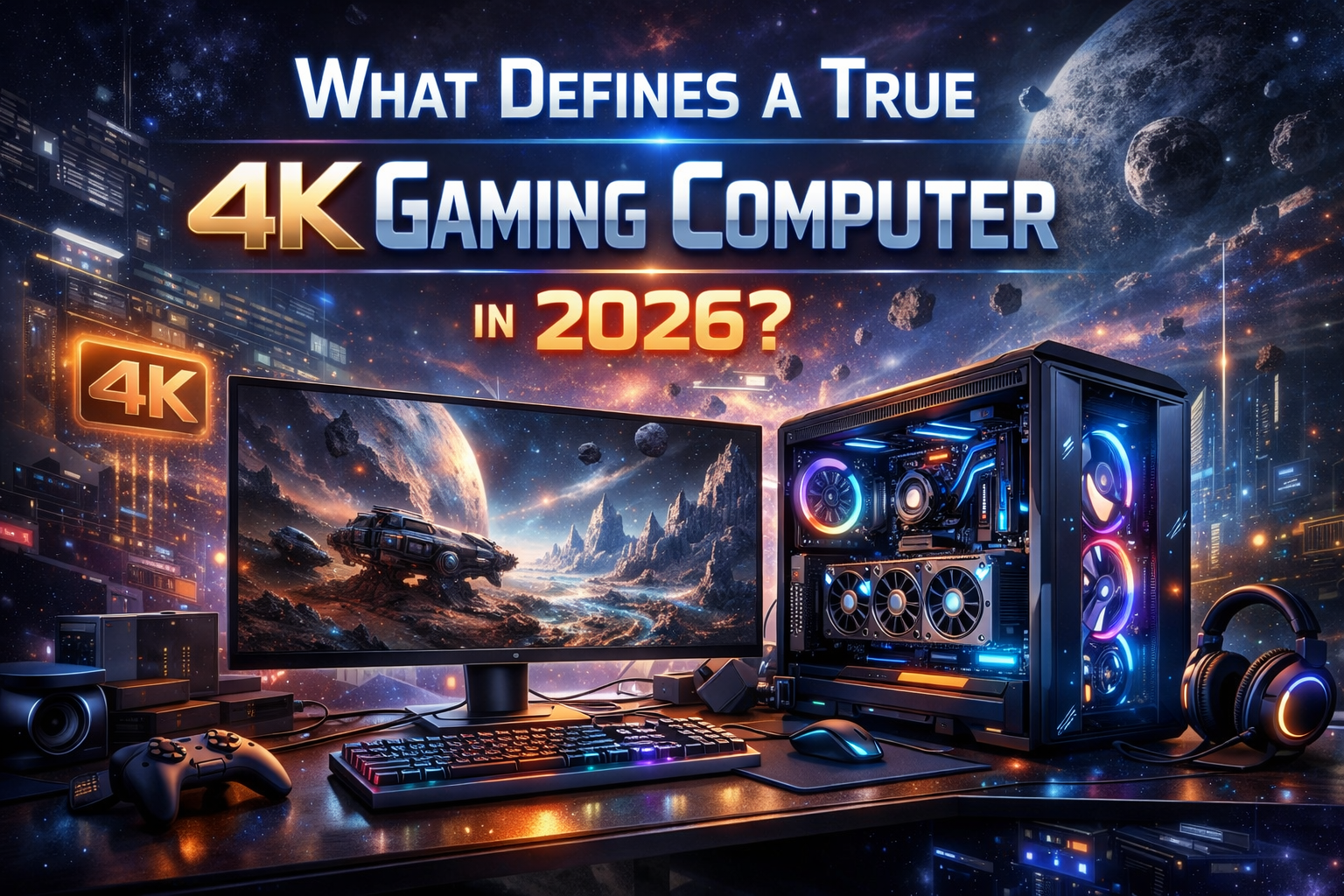
The landscape of high-fidelity entertainment has shifted dramatically this year. While previous hardware generations struggled to balance resolution with frame rates, 2026 marks the era where valid ultra-high-definition performance finally becomes accessible to enthusiasts without heavy compromises. When you look for a 4k gaming computer today, you are no longer hunting for a machine that merely outputs a video signal at 3840 x 2160; you are demanding a system that dominates that resolution with ease. Retailers like HyperCyber have set a high bar regarding this standard. Their prebuilt rigs combine aesthetic precision with the thermal headroom required for this year’s most demanding hardware.
The Silicon Engine: GPU and CPU Standards
A “true” 4K experience in 2026 requires components that can handle native rendering at high refresh rates. The days of relying entirely on aggressive upscaling to hit 60 FPS are over. The baseline for entry has moved significantly higher.
- Graphics processing: the arrival of NVIDIA’s RTX 50-series and AMD’s RDNA 5 architecture has changed the math. A genuine 4K card must feature at least 24 GB of GDDR7 memory to handle the uncompressed textures of modern open-world titles.
- Central processing: to feed these hungry GPUs, processors like the Intel “Nova Lake” or AMD’s Ryzen 10000 series are essential. These chips utilize advanced 3nm fabrication processes to minimize bottlenecks.
- Thermal management: with GPUs drawing upwards of 450W, liquid cooling is no longer optional for the top tier. Custom loops or high-performance AIOs are standard to prevent thermal throttling during extended sessions.
Hardware alone does not tell the full story. The integration of these parts determines whether a system can sustain peak performance or if it will falter under load.
Memory and Storage Velocity
Speed is the defining characteristic of 2026. The refinement of high-frequency DDR5 modules and the maturation of PCIe Gen 5 storage have eliminated loading screens almost entirely.
- System memory: 32 GB is the absolute floor, but 64 GB of high-speed RAM is the recommendation for 4K textures and simultaneous streaming.
- Storage throughput: a true 4K system utilizes NVMe SSDs with read speeds exceeding 14,000 MB/s. This allows assets to stream directly from storage to VRAM, bypassing the CPU and freeing up resources.
- Bus bandwidth: the adoption of PCIe Gen 6 lanes on enthusiast motherboards provides the massive bandwidth required for next-generation peripherals and capture cards.
These specifications create an ecosystem where the hardware waits for the user, never the other way around.
The Display Connection
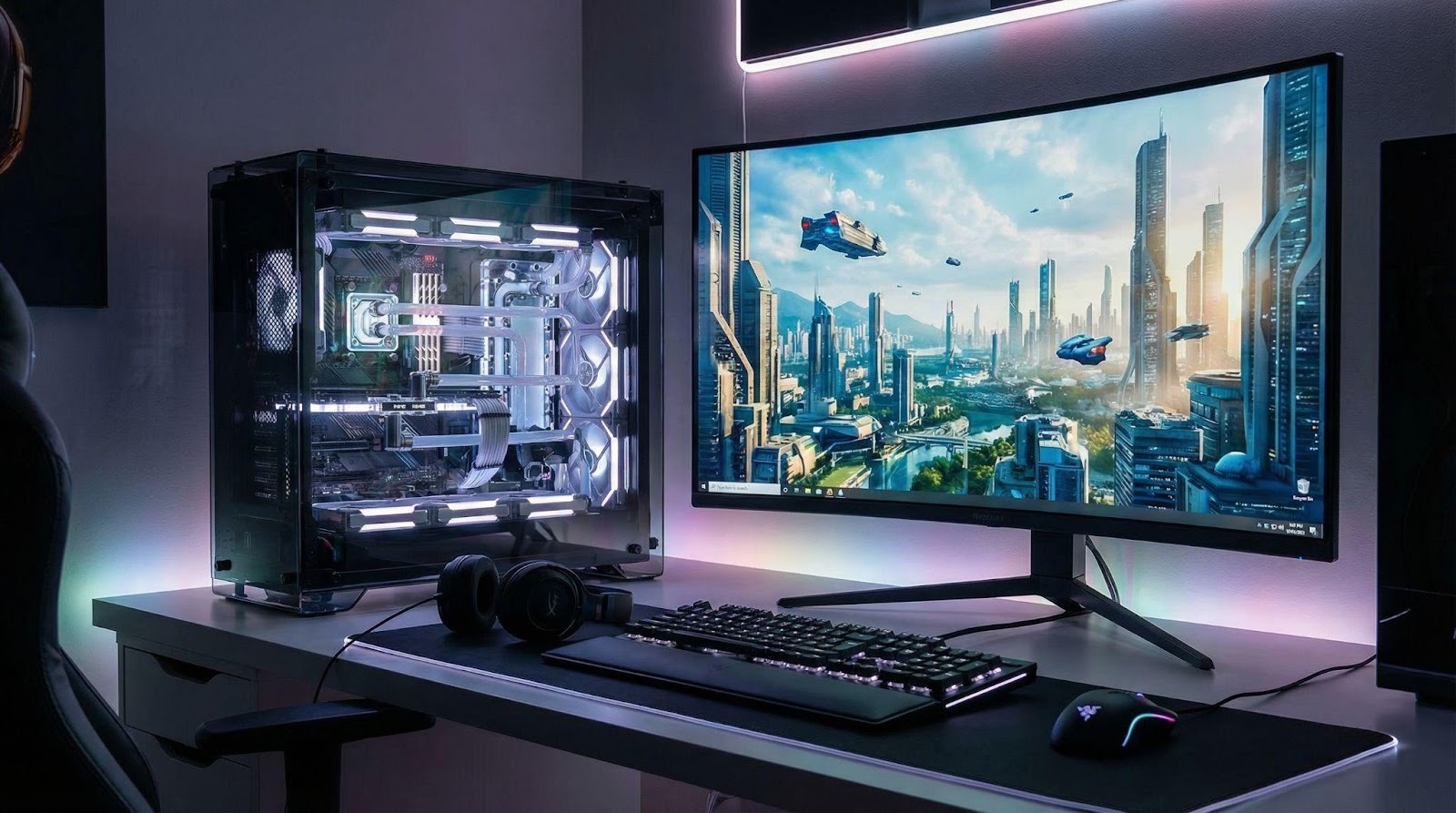
A computer is only as good as the image it produces. In 2026, the definition of 4K gaming is inextricably linked to the display technology that presents it. We have moved past simple 60Hz panels into a realm of extreme fluidity.
- Connectivity: DisplayPort 2.1 is mandatory. It provides the bandwidth necessary to drive 4K monitors at 240Hz without chroma subsampling, a feat that exceeded the raw bandwidth limits of the older HDMI 2.1 standard.
- Panel technology: OLED and MicroLED have replaced IPS as the gold standard. The infinite contrast ratios of these panels are vital for proper HDR implementation, which is now a core part of game art direction.
- Response times: we now expect sub-0.5ms gray-to-gray response times. At 4K, motion clarity is paramount, and slow pixel transitions can ruin the immersion of a high-resolution image.
The synergy between the tower and the monitor is what ultimately delivers the experience. A powerful tower connected to an outdated screen wastes the potential of the GPU, while a top-tier monitor cannot shine without the frame rates to drive it.
The Verdict on Performance
So, what constitutes a “True 4K” machine in 2026? It is a system capable of maintaining a locked 120 FPS in AAA titles at 4K resolution, utilizing advanced AI reconstruction to maintain path-traced lighting without sacrificing fluidity. It is a machine that does not ask you to lower settings to “High” or “Medium” but invites you to maximize every slider. It represents the point where visual fidelity meets competitive responsiveness, offering an experience that is uncompromisingly sharp and impossibly smooth.